Plumbing Emergency in Reading PA: What to Do Right Now, Step by Step
Stop the Water First. Everything Else Comes After.
In Reading, a busted pipe does not wait for you to figure out your next move, so skip the searching and go shut off your water right now. Grab the main shutoff valve and turn it clockwise until it stops moving.
If you cannot find the main valve fast, do not waste time hunting for it. Shut off the valve closest to the leak instead. Every toilet, sink, and appliance has its own valve right behind or beneath it.
Do not try to figure out what broke yet. Right now, stop the water. Everything else comes later. Get it off, then breathe.
Where Is Your Main Shut-Off Valve in a Reading Row Home or Twin?
In most pre-1960 row homes around Shillington, Kenhorst, and Wyomissing, the main shut-off valve is in the basement. Walk to the front wall closest to the street. The water supply line comes in through the foundation there, and the valve sits right on that line, usually within a few feet of where it enters the house.
What does it look like? In older homes around Cumru Township and Shillington, you are probably looking at a gate valve. That is the one with a round wheel handle, like a small steering wheel. You have to turn it several full rotations to close it. Turn slowly and steadily. These valves are often stiff or corroded after sitting untouched for years, and forcing them hard can crack the body and make your problem much worse.
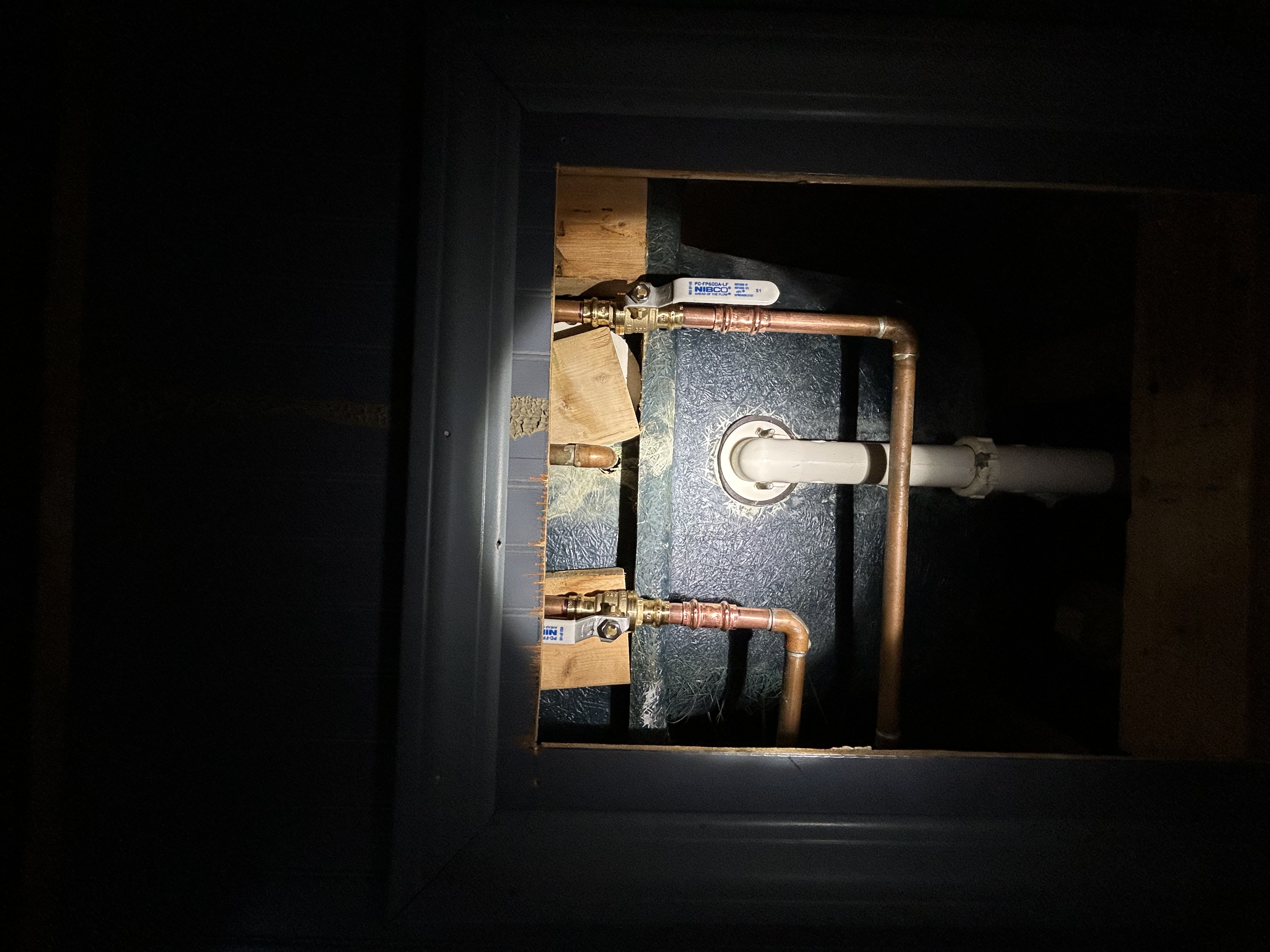
If your twin or split-level in Exeter Township had plumbing work done in the last 20 years, someone may have swapped in a ball valve. Ball valves have a lever handle. One quarter turn. That is all. Fast and reliable.
What to Do If the Valve Will Not Turn
If the main shutoff will not budge, do not force it. The curb stop out at the street belongs to your water authority rather than to you, and a broken one gets billed back to the homeowner.
Call your water authority and ask them to shut off service at the street. The number is on your bill. Then call us right away.
Do not wrestle with stuck valves. Every minute counts.
Safe Temporary Fixes While You Wait (And What Not to Do)
While you wait for help, there are a few things you can do to slow the damage. Keep to controlling the water rather than trying to fix the pipe.
Use towels, buckets, and plastic sheeting to control water flow and protect your subfloor and base walls. Water sitting against those areas causes rot and mold fast, especially in older Reading homes with wood subfloors that have already seen decades of humidity.
Keep it simple. Slow the water, protect the floors, and wait for help.
How to Keep Water Damage From Spreading to Other Rooms
Protect Your Walls
Lay towels or mop heads along the base of every wall near the leak. Drywall soaks up water fast, and once it does, you are looking at mold and rot on top of the original problem.
Control Ceiling Leaks
If water is pooling on an upper floor, get a bucket under the drip right away. If a spot on the ceiling looks swollen or bulging, stay out from under it and call us. A loaded ceiling holds wiring and light fixtures as well as water, so it is not something to open up yourself.
Move Your Belongings
Move furniture, rugs, and anything sitting on the floor away from the wet area immediately. Wood absorbs water in minutes, not hours.
Seasonal Risks in Reading: What Changes in January Versus July
January and February
January and February in the Schuylkill River valley are serious. Overnight lows can drop into the single digits, and that cold hits exterior walls fast. Brick row homes throughout Shillington and Kenhorst are especially vulnerable because older construction has less insulation in the walls, and pipes near exterior surfaces freeze faster than most homeowners expect.
If you wake up with no water pressure and it is below 20 degrees outside, assume a frozen pipe. Do not grab a torch or open flame to thaw it. Use a hair dryer on the lowest heat setting, starting at the faucet end and working back toward the wall slowly. Never use one while standing in water, and plug into a GFCI outlet. Have towels ready because once that pipe opens, water moves fast.
July and August
July and August bring different problems. High heat and humidity push water heaters, supply lines, and older fixtures to their limit. Emergency calls spike across Berks County during heat waves. Rubber seals and supply line connections that held all winter can fail when temperatures stay above 90 for days at a stretch.
What to Tell the Plumber When You Call. Have This Ready.
Describe What You See
Tell us what you see: where the water is coming from, whether it is a pipe, fixture, or appliance, and whether water is still flowing or has stopped.
Share What You've Done
Tell us what you already did. Did you shut off the main valve, the curb stop, or a fixture shutoff? Did the valve turn all the way or only part of the way? That detail matters.
Describe Your Home
Tell us about your place: row home, twin, or detached. Basement finished or unfinished. A neighbor or tenant below the leak. The age of the house if you know it.
Frequently Asked Questions About Plumbing Emergencies in Reading
What counts as a true plumbing emergency?
A true emergency is anything that can damage your property in the next few minutes. Active pipe bursts. Sewage backing up into the house. Water pooling near electrical panels. A slow-dripping faucet or running toilet can wait until morning.
What if I can't reach my main shutoff valve?
This is common in Reading's older rowhomes and twin houses because utility rooms sometimes sit behind locked doors in shared spaces. If you cannot get to the main valve, call your water authority and ask them to shut off the curb stop at the street. Do not wait. Water damage adds up fast.
Should I try to patch the pipe myself before the plumber arrives?
You can wrap a burst section loosely with a towel to slow the spray. That is about as far as you should go. Skip the epoxy putty, the pipe tape, and the clamp kits sold at hardware stores because those products can make the repair harder and cost more when a plumber arrives. Your job right now is to stop water flow and stay safe.
How quickly can a plumber get to my home in Reading?
That depends on the time of day, traffic near the 422 corridor, and how many calls are already in queue. The best thing you can do is call the moment you know you have a problem. The sooner you are in the queue, the sooner someone is heading your way. Do not wait to see if it gets worse.
Does the age of my Reading home affect how bad a plumbing emergency can get?
Yes, and it matters more than most people realize. Homes built before 1960, which covers a large part of Shillington, Kenhorst, and Cumru Township, often have galvanized steel or cast iron supply and drain lines. Those materials corrode from the inside over decades. One cracked section can mean adjacent pipe is close behind. Older homes are not doomed, but they do require faster action and a crew that knows what they are looking at.
How do I reach a plumber for an emergency in Reading?
If you're dealing with this in Reading, we can help. JB Plumbing HVAC and Construction knows Berks County construction and responds to plumbing emergencies throughout the area, from the older row homes in Shillington to the twins in Exeter Township. PA HIC Reg. #PA078141. Call (610) 621-3452 and have your address ready so the crew can head your way with the right parts.
Need Help With Your Home?
Family-owned in Reading, PA since 2011. Plumbing, HVAC, and remodeling done right the first time.